INNOVATION
The Swiss Startup That Ends Forever Chemicals
Oxyle validates its proprietary PFAS destruction technology in pilots across Europe, targeting mobile compounds that conventional approaches cannot capture
1 Jun 2026
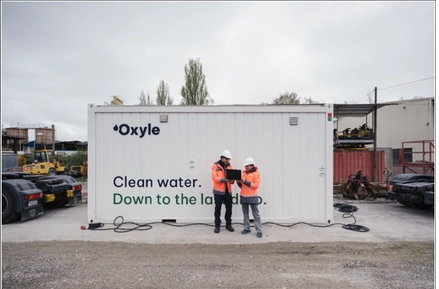
Europe's water sector has been stuck in an expensive loop. Standard treatment technologies extract PFAS from water, concentrate them into carbon or membranes, and hand them off to a landfill or incinerator for disposal. Oxyle, a prominent ETH Zurich spin-off and winner of the 2026 Green Business Award, is now breaking that cycle.
Unlike traditional methods that focus on capturing contaminants and concentrating them rather than eliminating them, Oxyle’s approach is engineered to sever the persistent carbon-fluorine bonds. Their core destruction technology, known as OxLight, uses a proprietary photochemical reduction method where UV light and mediator chemicals are combined to break down PFAS molecules directly. Instead of merely moving the pollution, the process permanently destroys PFAS on-site, converting them into harmless byproducts like fluoride, organic acids and spent mediators. This includes the hardest-to-treat compounds: short- and ultra-short-chain PFAS such as TFA and PFBA, which are widely used in industrial processes or as degradation products and missed by most conventional systems entirely.
While the industry prepares for its first plant to begin operation, Oxyle is already validating its approach through active pilots running across Europe. These modular systems are designed for seamless integration at industrial and remediation sites, limiting additional cost and operational complexity in its management.
Field-validated results confirm the technology's effectiveness: an on-site pilot recently treated several hundred liters of industrial wastewater, achieving >99% degradation of an ultra-short-chain C3-PFAS compound, while customer proof-of-concepts demonstrated >99% elimination of TFA in contaminated groundwater.
As the industry shifts toward permanent PFAS destruction, the focus is set on a more proactive model: stopping contamination at its origin rather than managing it downstream. "Water is at the center of the climate crisis," says Dr. Fajer Mushtaq, CEO and co-founder of Oxyle. "How we treat and manage contaminated water today will be a decisive part of the solution for a cleaner, toxic-free future". For manufacturers and utilities alike, the ability to finally close the loop on forever chemicals is no longer a laboratory concept, but a scalable reality.
Related News


topics on the agenda
DUTCH KNOWLEDGE AND INNOVATION PROGRAMME PFAS SOIL
DAY 1: undefined
09:00 - 09:25
PFAS ABATEMENT AND DESTRUCTION USING SURFACE-MODIFIED GAC – “SEARCH, CAPTURE, AND DESTROY”
DAY 1: undefined
09:30 - 09:55
PFAS – A FOREVER SOLUTION TO A FOREVER CHEMICAL
DAY 1: undefined
10:00 - 10:25
SUBSCRIBE FOR UPDATES
By submitting, you agree to receive email communications from the event organizers, including upcoming promotions and discounted tickets, news, and access to related events.